
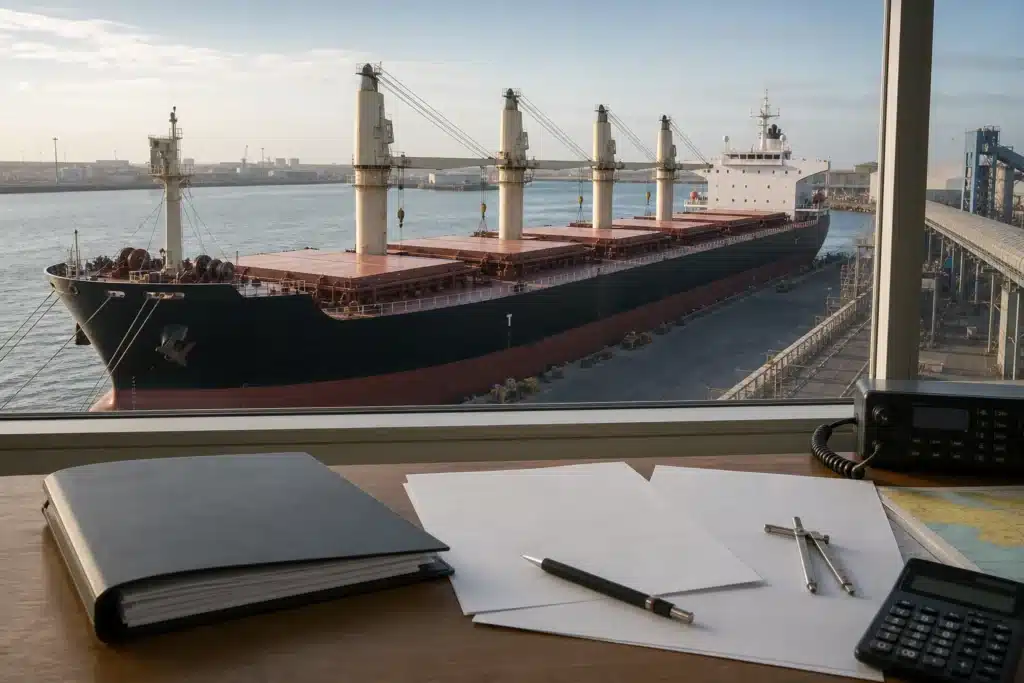
A charter party agreement guide is useful only when it connects contract wording to the vessel, cargo, port, and documents that will govern performance. In dry bulk and general cargo shipping, a fixture can look commercially sound at recap stage and still fail operationally if a draft limit, cargo stowage factor, hatch restriction, or notice requirement was not checked.
For cargo owners, charterers, traders, and brokers, the charter party is the operating framework for a voyage. It allocates time, cost, responsibility, and risk. It does not remove the need for disciplined pre-fixture review or close post-fixture control.
Start With the Charter Type and Commercial Purpose
A voyage charter usually commits the vessel to carry an agreed cargo between named loading and discharge ranges for freight. The owner provides the ship, crew, and normal vessel operation. The charterer commonly controls cargo arrangements within the agreed terms and takes the main exposure to loading and discharge performance.
A time charter hires the vessel for a period. The charterer directs lawful employment within the trading limits, while the owner remains responsible for navigation, crew, and technical management. Hire, bunkers, speed and consumption warranties, off-hire events, and performance claims require careful attention.
The distinction matters immediately. Under a voyage charter, laytime and demurrage often drive the financial outcome. Under a time charter, hire continuity, bunker planning, port rotation, and employment orders may be equally decisive. Standard forms can provide a starting point, but riders and recap terms often determine the real allocation of risk. The signed wording must be read as one document, including incorporated terms and amendments.
Vessel Suitability Must Be Proven Before Fixture
A cargo quantity alone does not establish whether a vessel is suitable. The proposed parcel must fit the ship safely, physically, and contractually.
Start with deadweight, draft, and cargo intake. A vessel may have sufficient deadweight on paper but be unable to load the intended quantity at a restricted berth, river port, or canal approach. Check the maximum sailing draft, berth draft, channel restrictions, tidal windows, fresh-water allowance, and the vessel’s TPC. A small draft miscalculation can leave cargo ashore, require lightering, or create a dispute over deadfreight exposure.
Stowage factor is equally important. Dense cargoes may be deadweight-limited. Light cargoes may fill available hold space before the vessel reaches the contractual quantity. For steel products and general cargo, hatch dimensions, tween-deck arrangements where applicable, tank-top strength, lashing needs, and port handling method can decide suitability. For bulk cargo, assess hold capacity, trimming requirements, cargo distribution, stability, and the suitability of any grabs or shore equipment.
Gear is not a generic description. Confirm whether the vessel is geared or gearless, the number and safe working load of cranes, grab compatibility, and any grab restrictions in the charter party or terminal rules. If loading or discharge relies on shore equipment, the port’s actual capability must be confirmed through the agent, terminal, and relevant port information. A stated loading rate is not a guarantee that equipment, labor, berth access, or cargo supply will support it.
Air draft can be as restrictive as water draft. Bridges, loaders, shore cranes, and overhead obstructions may limit a vessel’s passage or berth position. This is especially relevant where a voyage involves river approaches, enclosed terminals, or ports with fixed loading arrangements.
Laycan, NOR, and Readiness Control the Clock
Laycan sets the agreed loading window. Missing it can give the charterer cancellation rights, subject to the charter party wording and any valid extension. A workable laycan requires more than a broad estimate of the vessel’s open position. Review the previous voyage, discharge prospects, bunkering plan, weather exposure, transit restrictions, and likely port delays.
Notice of readiness, or NOR, is often the point at which laytime begins to move toward exposure. The charter party must be checked for the required form of NOR, permitted tendering place, office hours, weather conditions, free pratique, customs clearance, and whether the vessel must be physically and legally ready in all respects.
A vessel that arrives but has unclean holds, unresolved cargo residue, deficient certificates, or insufficient ballast arrangements may not be ready to tender a valid NOR. The result can be lost time, a rejected notice, and a later laytime dispute. Hold readiness should be controlled well before arrival. Instructions should identify cargo-specific cleanliness standards, inspection arrangements, and the party responsible for any remedial work.
Read the Laytime Clause as an Operating Instruction
Laytime clauses are not boilerplate. They decide who carries the cost of delay. The agreed rate may be expressed as tons per weather working day, working day, or another defined basis. Terms such as SHINC, SHEX, WIFPON, WIBON, and whether time counts before or after berth affect the calculation materially.
The key question is not simply, “What is the stated rate?” It is, “When does time start, what stops it, and what evidence proves the exception?” Rain, holidays, shifting, breakdowns, strikes, congestion, and bad weather may have different consequences depending on the exact clause.
Port productivity should be assessed before fixture, but it should not be treated as fixed. Cargo availability, berth prospects, labor arrangements, weather, equipment reliability, and terminal sequencing can change. For Black Sea and Mediterranean trading, seasonal weather, Turkish Straits transit conditions, local agency coordination, and berth limitations can all affect the practical timing of a voyage. Current restrictions and local requirements require confirmation from the relevant authority and appointed agent.
Post-Fixture Discipline Protects the Fixture
Once the charter party is signed, the work becomes more detailed. Clear voyage orders should identify the cargo, quantity tolerance, load and discharge ports, charter party references, freight terms, bills of lading instructions, and notification requirements. Ambiguous instructions create avoidable delay and make later claims harder to defend.
Agency nomination should be followed by a prompt pro forma disbursement account review. A PDA is an estimate, not a final cost. It should be checked against port calls, pilotage, towage, launches, husbandry items, cargo expenses, and any anticipated special requirements. After completion, the disbursement account should be reviewed against supporting vouchers and the operational record.
Stowage planning needs coordination among the master, charterer, cargo interests, and terminal where relevant. The plan must support stability, stress limits, draft restrictions, cargo segregation, discharge sequence, and safe access. A late request to alter a cargo distribution can affect trim, draft, or port rotation. It should never be assumed to be operationally neutral.
Emiroglu shipping applies this practical approach across dry bulk and general cargo work, linking commercial fixture terms with voyage instructions, port coordination, and document control from fixture through file closure.
Documents Must Match the Contract and the Facts
The mate’s receipt is a primary cargo document. Its quantity, condition remarks, and clauses should be checked before bills of lading are issued. A clean bill of lading should not be issued where the master has valid grounds to record cargo condition concerns. Any request to change, omit, or backdate wording needs case-specific review under the charter party, applicable law, and P&I guidance.
Draft bills of lading must be aligned with the mate’s receipts, charter party requirements, letter of credit instructions where applicable, and the master’s authority. The freight invoice should reflect the agreed freight basis, quantity, payment timing, and any deductions or commissions permitted by the contract. Keep evidence of payment, including SWIFT confirmation where relevant.
Original bills of lading remain central to delivery risk. If cargo is to be released without originals, any letter of indemnity procedure must follow the charter party and the owner’s internal requirements. A letter of indemnity does not automatically protect a party from all delivery claims. P&I advice and legal review may be required for the specific facts.
Draft surveys also require attention. Record the surveyor’s reports, vessel figures, water density, soundings, and protests where figures are disputed. A letter of protest does not solve a problem by itself, but it can preserve a contemporaneous record of what occurred and when.
Close the File With Evidence, Not Assumptions
Laytime calculation should begin with a complete time sheet and supporting documents: NOR, statements of facts, berth records, weather reports where relevant, notices, protest letters, and correspondence on interruptions. Check every exception against the wording actually agreed. A delay may be operationally obvious but still not qualify as an excluded period under the charter party.
Demurrage and despatch calculations should show the calculation method, allowed laytime, counted time, excluded time, and applicable rate. Prompt, organized presentation improves the chance of resolving a claim commercially. It also helps identify recurring issues in cargo nomination, port selection, instructions, or document flow.
A well-run fixture is not defined by a clean recap alone. It is defined by whether the vessel can perform the employment safely, whether each party receives timely and accurate information, and whether the file can explain every material event after the voyage is complete. Before agreeing the next fixture, ask the operational question that matters most: can the contract be performed as written at the ports, with this cargo, on this vessel?