
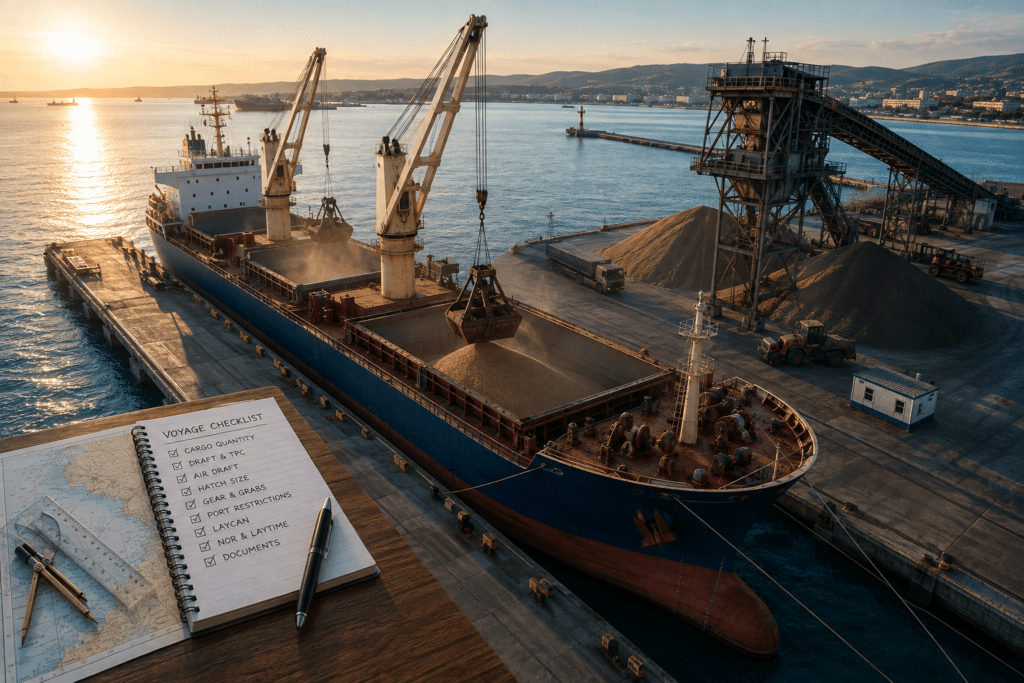
A coaster can look suitable on a cargo recap and still fail the voyage plan at the first restricted berth. A few centimeters of draft, an inadequate hatch opening, or a missed air-draft limit can turn an apparently workable fixture into delay, extra cost, or a dispute. Knowing how to choose coaster vessels means testing the ship against the full commercial and operational chain, not selecting by deadweight alone.
For dry bulk and general cargo, the correct vessel is the one that can load, sail, discharge, document the cargo, and complete laytime within the agreed charter-party framework. Every assumption should be checked against the vessel’s approved particulars, the terminal or port restrictions, the cargo description, and the nominated voyage.
Start With the Cargo, Not the Vessel Size
Cargo quantity is the first filter, but it is not the final answer. A 3,000-metric-ton parcel may fit within a coaster’s deadweight capacity while still creating a draft issue at the load port, discharge port, or both. The usable intake depends on bunkers, freshwater, stores, constants, density of water, and any route-specific consumption. A vessel’s summer deadweight is not necessarily the quantity it can carry on the intended voyage.
Stowage factor must be checked next. Low-stowage-factor cargoes such as minerals may reach the vessel’s deadweight limit before the holds are full. High-stowage-factor cargoes may fill the holds before the vessel reaches its contractual quantity. Grain, fertilizer, steel products, and agricultural commodities each raise different questions about hold capacity, trimming, separation, ventilation, contamination, and cargo securing.
For general cargo, hatch dimensions and hold geometry can be decisive. Steel coils, project pieces, bagged cargo, or long products may physically fit in the hold but be difficult to load safely through the hatch. The loading method also matters. A shore crane, vessel gear, forklift operation, or grab discharge requires compatible lifting arrangements and clear agreement on responsibility.
A practical pre-fixture file should establish the cargo’s quantity range, stowage factor, loading and discharge method, cargo care requirements, and any special clauses. If the charterer requires a full cargo, the operator must calculate realistic intake rather than rely on a broad deadweight description.
How to Choose Coaster Vessels Against Port Limits
Port restrictions often decide the fixture before freight is negotiated. The relevant question is not whether the vessel has called at a similar port before. It is whether it can call at the nominated berth on the proposed dates and under the current restrictions.
Draft, TPC, and water density
Maximum sailing draft, berth draft, channel draft, and tidal windows must be reviewed separately. A vessel may berth safely but lack sufficient departure draft after loading. In brackish or fresh water, the vessel will sink deeper than in seawater for the same displacement. TPC helps calculate how much additional cargo changes draft, but the calculation must use confirmed vessel data and actual water density.
A cargo order that allows only a narrow draft margin needs particular care. The agent should confirm berth depth, chart datum, dredging status where relevant, tide requirements, and local under-keel-clearance practice. These are time-sensitive matters. Port authority notices, agent advice, and charter-party wording require case-specific confirmation.
Air draft, beam, and navigation limits
Air draft is easy to miss on river, canal, and bridge-restricted voyages. A vessel that meets draft limits may still be unable to pass below a bridge or enter a covered loading facility. Beam, length overall, mast height, turning-basin limits, and tug requirements can also affect acceptance.
This is especially relevant for voyages connected with constrained waterways and smaller Black Sea or Mediterranean ports. Turkish Straits passage, weather, traffic measures, and local authority requirements should never be assumed from a previous voyage. Confirm the applicable conditions before finalizing the employment plan.
Berth prospects and productivity
A berth nomination is not the same as a confirmed berth prospect. The operator should ask whether the terminal accepts the vessel’s dimensions, loading method, cargo type, and gear configuration. Expected loading and discharge rates influence bunker consumption, port costs, ETA planning, and laytime exposure, but they should be treated as estimates until supported by the charter party and local information.
Slow discharge can be commercially manageable if it is priced and planned. It becomes a problem when the vessel has limited bunker margin, a tight laycan for its next employment, or unclear demurrage protection.
Check Gear, Grabs, and Hold Readiness
The terms “geared” and “grab-equipped” do not answer every operational question. Confirm the number and safe working load of cranes, outreach, grab type and capacity, wire condition, power limitations, and whether shore labor can operate the equipment under local practice. A discharge port may require ship’s grabs, prohibit them, or accept them only with specified arrangements.
Cargo damage risk must be considered alongside speed. Grabs can increase discharge productivity for some bulk cargoes, but unsuitable grabs or poor trimming can damage holds, create spillage, or leave substantial residues. For sensitive cargoes, the shipper, charterer, surveyor, and vessel should align on cleanliness standards and inspection requirements before loading.
Hold readiness is a commercial issue as well as an operational one. A rejected hold can delay commencement of loading and create arguments over notice of readiness, laytime, and responsibility. Cleaning instructions, prior cargo history, inspection timing, and any P&I attendance should be addressed early. P&I advice and local practice must be considered on the facts of the voyage.
Test Laycan and Route Feasibility
A vessel that is physically suitable may still be commercially unsuitable if it cannot meet laycan. Pre-fixture planning should account for the vessel’s prior employment, ballast passage, weather exposure, bunkering plan, straits or canal requirements, anticipated port stay, and time needed to prepare holds.
Weather is not a generic planning allowance. Seasonal swell may affect an exposed berth. Fog, ice, wind restrictions, rain interruptions, and sea conditions may change loading, discharge, or passage performance. The correct allowance depends on the route, season, vessel, and port. It should be supported by current local information rather than a standard percentage added to the voyage estimate.
Bunker planning must match the vessel’s actual consumption profile, available bunker ports, delivery terms, and expected waiting time. A low-priced freight idea can lose value if bunkers must be taken at an unsuitable location or if the voyage leaves insufficient contingency for weather or congestion. Any sanctions, war-risk, trading restrictions, or permission requirements need separate, current review under the charter party and applicable rules.
Make the Charter Party Operationally Usable
The recap and charter party should translate the voyage plan into clear obligations. Cargo quantity and tolerance, laycan, loading and discharge ports, safe berth or safe port wording, loading and discharge rates, demurrage and despatch terms, NOR provisions, commission, freight payment, and document requirements must work together.
Ambiguous wording creates avoidable post-fixture work. For example, “customary quick despatch” may be understood differently by the parties and local terminal. A stated discharge rate is more useful, but only if the applicable working time, weather exceptions, shifting, holidays, and whether time counts before or after berth are also clear.
The NOR clause needs close attention. Whether notice can be tendered at anchorage, outside port limits, or only after berthing may materially affect laytime. The charter party governs, subject to the facts, port practice, and any legal advice required. It should not be replaced by assumptions based on a prior fixture.
Manage the Vessel After Fixture
Choosing the vessel continues after the charter party is signed. The post-fixture team should issue clear voyage orders, confirm agency nomination, circulate cargo and port instructions, and maintain disciplined ETA notices. The agent’s proforma disbursement account, or PDA, should be reviewed against the intended call: port dues, towage, pilotage, agency fees, launch services, freshwater, garbage, and any cargo-related cost items require scrutiny.
Before loading, the vessel needs a workable stowage plan, confirmed hold readiness, and a clear chain for instructions. Draft surveys should be arranged when agreed or required. At the load port, mate’s receipts must accurately reflect the cargo received and any relevant remarks. Draft bills of lading should be checked against the charter party, mate’s receipts, cargo figures, shipper details, freight terms, and letter-of-credit requirements where applicable.
Do not treat document control as an administrative afterthought. Original bills of lading, freight invoices, and SWIFT payment evidence affect release and cash-flow follow-up. If an original bill is unavailable, a letter of indemnity procedure may be proposed, but its wording, bank support where required, P&I implications, and acceptability must be assessed case by case. It is not an automatic substitute for the original bill.
At discharge, records preserve the commercial position. Keep statements of facts, timesheets, notices, survey reports, letters of protest, and correspondence organized from the first port call. Review the final disbursement account, or D/A, against the PDA and supporting vouchers. Then calculate laytime under the charter party, identify demurrage or despatch exposure, and close the freight and document file with evidence rather than recollection.
A Decision Framework for Charterers and Cargo Interests
A suitable coaster passes three tests at the same time: it can carry the cargo safely within its physical limits, call at the intended ports within their restrictions, and perform the voyage within the commercial terms. Failure in any one test can change the economics of the fixture.
For a cargo owner or broker, the most useful questions are direct: What is the realistic intake on this route? What is the controlling draft or air-draft restriction? Can the hatch and gear handle the cargo? What productivity can the port reasonably support? When can valid NOR be tendered? Which documents must be ready before loading and before release?
emiroglu shipping approaches these questions through practical vessel operations and post-fixture discipline, drawing on dry bulk and general cargo experience since 1998. The right coaster is not simply the available ship. It is the vessel whose cargo fit, port access, voyage timing, and documentary process have been checked closely enough to support the fixture when real conditions begin to move.