
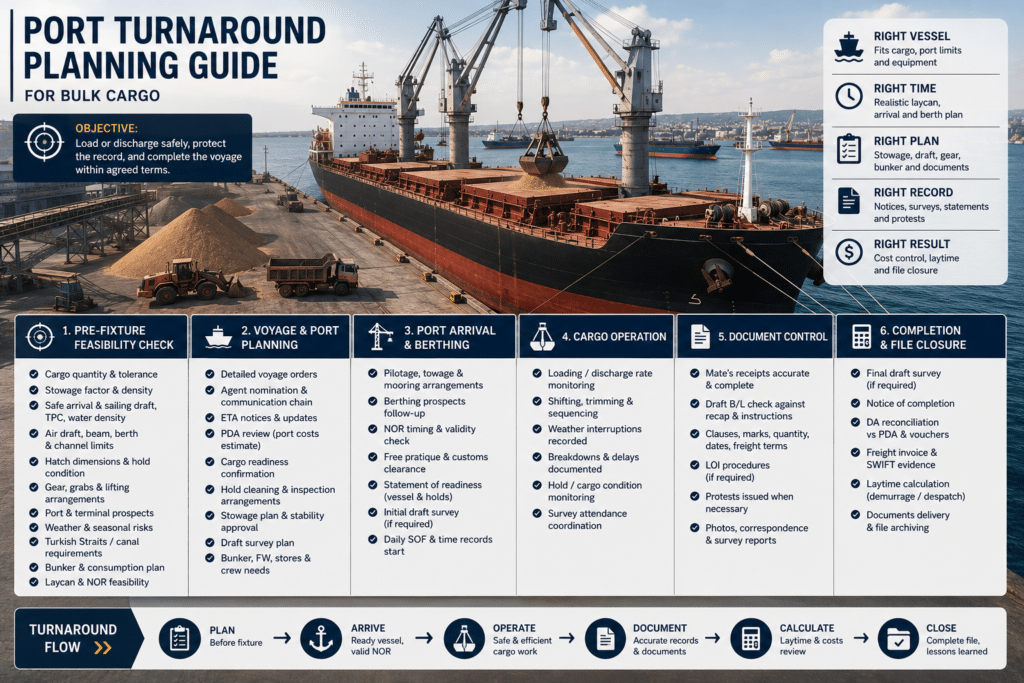
A berth window can look workable at fixture stage and still fail when the vessel reaches the port limit. A few centimeters of draft, an unconfirmed grab arrangement, a slow draft survey, or a mate’s receipt carrying the wrong cargo description can change both turnaround time and claim exposure. This port turnaround planning guide sets out the checks that connect charter-party commitments with actual vessel performance.
For dry bulk and general cargo, turnaround is not simply the hours between arrival and sailing. It begins when the employment is assessed and continues through file closure. The objective is clear: place a suitable vessel at a suitable berth, load or discharge safely and correctly, protect the documentary record, and calculate time and money under the agreed charter-party terms.
Start the port turnaround planning guide before fixture
A port call should be tested before the fixture is concluded. The cargo quantity must fit the vessel’s safe intake, not merely its deadweight. Safe intake depends on arrival and sailing drafts, water density, seasonal or local load line limits, TPC, bunkers, freshwater, stores, and any ballast requirement. A berth may publish a nominal maximum draft, but the operative limit can depend on tide, channel condition, under-keel clearance policy, or the terminal’s own restriction. The agent and relevant authority should confirm the current position for the intended call.
Stowage factor is equally material. A low-stowage-factor cargo may be weight-limited. A high-stowage-factor cargo may fill the holds before the vessel reaches the nominated quantity. For steel products and general cargo, hatch dimensions, hold geometry, tanktop strength, lifting arrangements, and securing requirements may control suitability. For grain, fertilizer, minerals, and agricultural commodities, the loading sequence, trimming method, segregation, ventilation, and contamination risk require early attention.
The vessel’s gear must match the terminal arrangement. A geared vessel does not automatically solve a shore-side shortage. Operators should establish whether cranes, grabs, hoppers, loaders, shore gear, and power supply are available and permitted, who supplies them, and who bears delay or damage risk. The charter party may allocate these issues, but its wording must be read alongside the port’s practical rules.
Laycan should also be treated as an operational commitment, not a date range in isolation. Can the vessel complete her previous employment, take bunkers, pass required straits or canals, and arrive in a condition that permits a valid notice of readiness? Weather, waiting time, pilotage, Turkish Straits transit conditions, and bunkering plans can all affect the answer. A forecast is useful for planning, but it is not a performance guarantee.
Build one working plan for owners, charterers, and agents
Once fixed, the voyage order should translate the fixture into clear instructions. It should identify the cargo, quantity tolerance, load and discharge ports, laycan, freight terms, charter-party time provisions, nominated agents, cargo-document requirements, and reporting deadlines. Ambiguous instructions create avoidable differences between the commercial file, the master’s understanding, and the agent’s port arrangements.
The operations team should then check the port sequence against the vessel’s physical and documentary position. This includes expected ETA, bunkers on arrival and departure, ballast condition, draft limits, air draft where bridges or loaders are relevant, berth prospects, cargo readiness, and expected loading or discharge rates. Published productivity figures are only an input. Actual performance can be affected by rain, labor arrangements, hatch access, equipment breakdown, shift patterns, customs procedures, and survey delays.
A properly reviewed pro forma disbursement account, or PDA, is a planning document as well as a cost estimate. It should be checked for pilotage, towage, launch service, mooring, agency fees, husbandry items, customs attendance, garbage arrangements, freshwater, and any cargo-related attendance. Large differences between a PDA and a final disbursement account require explanation and supporting vouchers. Local tariffs, port practices, and agency terms need case-specific confirmation.
Agency nomination needs the same discipline. The agent coordinates the port call, but the master retains responsibility for the vessel and the signed shipboard record. Instructions should establish who issues ETA notices, who follows berth prospects, who arranges surveys, and who receives daily statements of facts. The master, operator, charterer, terminal, surveyor, and agent may each hold part of the information. Turnaround suffers when no one owns the next action.
Prepare holds, stability, and the loading sequence
Hold readiness is often treated as a last-minute matter. It should not be. The cargo’s condition and the charter-party standard determine what cleaning, inspection, drying, and evidence are necessary. If a hold is rejected, the cost is not limited to cleaning. The vessel may lose her loading turn, face a dispute over notice of readiness, or require a protest to preserve her position.
The stowage plan must work throughout the operation, not only at completion. It should account for stability, longitudinal strength, shear forces, bending moments, draft progression, trim, ballast exchange, and the terminal’s loading sequence. A cargo plan that produces an acceptable final condition can still create an unsafe intermediate stage. Where the cargo, port, or vessel requires specialized calculation or approval, the applicable class, flag, terminal, and local requirements must be verified.
Draft surveys need coordinated timing. Initial and final readings, water density, ballast figures, soundings, and surveyor attendance should be organized before cargo work begins. A disagreement over quantity becomes harder to resolve when the supporting observations are incomplete. If the master disagrees with a survey result, the record should state the basis of concern promptly and accurately.
Control the documents while cargo is moving
Cargo documents should be managed in parallel with operations. The mate’s receipt is the immediate shipboard record of cargo received. Its cargo description, quantity, apparent order and condition, marks, dates, and remarks matter because they influence the draft bill of lading. A clean bill should not be issued when the master has valid grounds to record an adverse condition.
Draft bills of lading must be checked against the fixture, mate’s receipts, letters of credit where applicable, cargo instructions, and the authority given to sign. Errors in consignee details, load-port dates, quantities, freight wording, or clausing can create delay and commercial exposure. The party authorized to sign should be identified before documents are presented, not after completion.
Letters of indemnity require particular care. An LOI may be proposed for delivery without original bills of lading or for another documentary issue, but it does not remove all risk. Its form, signatory authority, charter-party position, P&I guidance, and governing law must be reviewed for the specific case. The master should not rely on informal assurances.
Letters of protest serve a different purpose. They preserve a contemporaneous record when weather, shore equipment, cargo condition, berth delay, survey disagreement, or another event may affect rights. A protest is not a substitute for evidence. Statements of facts, logs, notices, emails, photographs where appropriate, and survey reports should tell the same factual story.
Measure time from arrival to file closure
Laytime analysis begins with the charter party. The wording determines what counts as arrival, when notice of readiness may be tendered, when time starts, which exceptions apply, and whether time is reversible or non-reversible. Port custom may be relevant only where the contract permits it. NOR validity is especially sensitive to berth status, free pratique, customs clearance, hold readiness, and the vessel’s readiness in all required respects.
Daily statements of facts should be reviewed while the events are fresh. Check stoppages against the time sheet: rain, shifting, breakdowns, holidays, waiting for cargo, waiting for berth, shore labor interruptions, and survey delays may have different treatment under different forms. Do not assume that a label used by the terminal decides the laytime result.
At completion, the operator should reconcile the final D/A with the PDA and vouchers, review freight invoices, and retain SWIFT evidence for payments. Original bills of lading, or approved LOI procedures where applicable, must be tracked until the file is complete. The laytime calculation should identify any demurrage or despatch exposure, supported by the charter party and the operational record. A timely review is more useful than a dispute assembled months later from partial documents.
emiroglu shipping applies this practical connection between chartering and vessel operations across dry bulk and general cargo work, including Black Sea and Mediterranean trades where port restrictions and timing frequently shape the commercial result.
A well-run turnaround does not depend on optimistic assumptions. It depends on asking the right question before each handover: is the vessel physically ready, is the port arrangement confirmed, and does the record support what happened? That discipline gives every party a clearer basis for the next decision.