
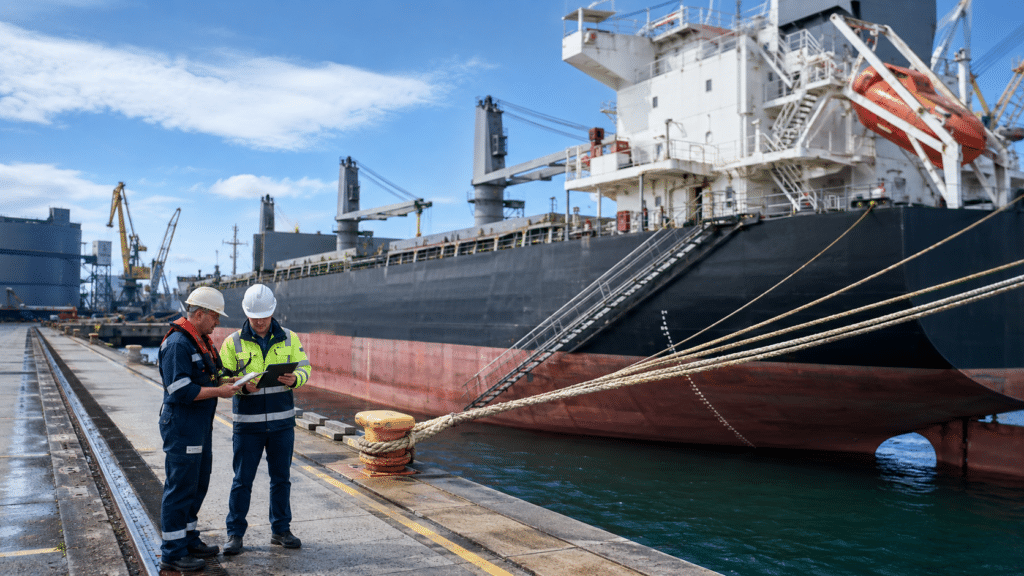
A vessel can be correctly fixed and still lose money at the port. The reason is often not the freight rate or the cargo itself. It is a missed ETA update, an unclear agency instruction, an unchecked draft limit, or a document issued with wording that does not match the charter party. Port agency services for vessels turn the commercial promise of a fixture into practical port performance.
For dry bulk and general cargo trades, the agent is the local operational point between the vessel, terminal, authorities, cargo interests, surveyors, and owners or operators. The quality of this coordination affects berth access, cargo readiness, disbursement control, documentation, and laytime exposure.
What port agency services for vessels cover
A port agent acts on the vessel’s behalf during a port call within the authority given by the principal. The scope varies by port, cargo, charter-party wording, and local practice. It commonly includes port clearance, berth coordination, notices to authorities, crew and husbandry arrangements, bunker coordination where required, cargo documentation support, and collection of port cost information.
For a charterer or cargo interest, agency work should not be treated as an administrative afterthought. It is a source of operational information. A competent agent can confirm what the terminal requires before arrival, identify local restrictions, report berth prospects, and explain which costs are likely to appear in the disbursement account.
The agent does not replace the master, terminal, surveyor, or contractual decision-maker. Each party retains its own responsibilities. The agent’s value lies in timely local execution and accurate reporting, allowing the operator to make decisions before a delay becomes a claim.
Agency appointment starts before the vessel arrives
The right time to appoint and instruct an agent is before the vessel’s ETA becomes urgent. A nomination should identify the principal, vessel, cargo, voyage reference, charter-party requirements, and authority limits. It should also state who may approve expenses, receive documents, or issue instructions affecting cargo operations.
Before arrival, the operator should ask for a pro forma disbursement account, usually called a PDA. This is an estimate, not a final cost. It should be reviewed against the expected port stay, vessel size, cargo quantity, pilotage, towage, launch services, port dues, agency fee, and any expected husbandry items.
A PDA that appears low may exclude items that arise later. A high PDA may reflect a cautious estimate, but it still requires explanation. The review should focus on scope, assumptions, local tariffs, exchange rates, taxes where applicable, and whether advances are required. Current tariffs and port requirements must be confirmed with the relevant authority or local agent for the specific call.
The port call must fit the vessel and cargo
Agency coordination is effective only when the voyage has been checked for physical feasibility. A vessel may be suitable for the cargo on paper but unsuitable for the loading or discharge berth.
Draft is often the first restriction. The relevant figure is not only the vessel’s arrival draft. It is the safe sailing draft after loading or before departure, taking account of density, tide where permitted, under-keel clearance, trim, squat, and port rules. TPC affects how much cargo can be added for each centimeter of draft, so it must be considered alongside the intended parcel size.
Air draft can be equally important at bridges, shore cranes, or covered loading facilities. Hatch dimensions, hatch cover condition, gear outreach, grab suitability, cargo handling method, and terminal limits also affect whether cargo can be loaded or discharged as planned. For geared vessels, the availability and condition of ship’s cranes and grabs should be checked against the cargo and terminal requirement before commitment.
Stowage factor determines the volume required for the cargo. A cargo quantity may fit the deadweight calculation but exceed hold capacity, or it may create stability, trim, or segregation concerns. The preliminary stowage plan should therefore be prepared early and then tested against port drafts, loading sequence, ballast capability, and safe access to each hold.
For calls connected with the Turkish Straits, the Black Sea, and Mediterranean ports, weather, traffic conditions, agency arrangements, and port limits can change the practical timing of a voyage. The applicable authority requirements, charter-party terms, and local notices must be verified for the intended transit or call. Assumptions based on an earlier voyage are not enough.
Clear instructions protect the vessel at the berth
Once the fixture is confirmed, the operator should issue voyage instructions that are complete and controlled. They should identify the cargo, quantity tolerance, loading or discharge terms, laycan, nominated ports or ranges, freight instructions, NOR requirements, and the documentary chain.
The agent needs the information required for formalities and cargo operations. The master needs instructions that are consistent with the charter party and operational reality. Conflicting instructions are a common source of delay, especially when shippers, receivers, charterers, and owners send directions through separate channels.
ETA notices require particular attention. The charter party may require notices at stated intervals, and the port may have its own pre-arrival reporting deadlines. The master should provide updates based on the best available passage information, while the operator and agent distribute notices to the required parties. A late or incorrectly addressed notice can affect berth planning and, depending on the contract wording, the validity of a notice of readiness.
Hold readiness also needs early control. The holds must be prepared for the agreed cargo and inspected under the applicable procedure. If a hold survey fails, the lost time can affect the loading program and create dispute over responsibility. The operator should retain inspection reports, photographs where relevant, cleaning records, and correspondence identifying any rejection or required corrective action.
Documents must follow the cargo operation
Port documentation is not merely a closing exercise. It controls payment, title, cargo claims, and laytime evidence. The agent, master, operator, and cargo side must work from consistent figures and instructions.
Draft surveys should be arranged when required by the contract, cargo practice, or party agreement. Survey results should be reviewed promptly, particularly if there is a significant difference between shore and ship figures. The issue may arise from water density, soundings, ballast, constants, calculation method, or a simple timing difference. The record should show what was measured, when, and in whose presence.
Mate’s receipts should accurately describe the cargo received and any observations made by the master. Draft bills of lading should match the mate’s receipts, charter-party instructions, and agreed cargo description. A bill of lading should never be released casually to solve a commercial deadline. If original bills are unavailable, any letter of indemnity procedure requires careful case-specific review under the charter party, applicable law, and P&I advice.
Letters of protest should be issued when facts need to be recorded, such as weather interruption, unsafe terminal practice, cargo damage concerns, contamination risk, delays, or disputed survey results. A protest does not settle liability, but it preserves a contemporaneous record. It should be factual, timely, and supported by logs, statements of facts, photographs, and correspondence where available.
Control costs and laytime after departure
The final disbursement account, or D/A, should be checked against the PDA and the supporting vouchers. Differences are not automatically errors. They may arise from a longer port stay, extra towage, launch attendance, revised port dues, crew requirements, or other instructed services. However, each material variance should be traceable to a documented event, service, tariff, or approval.
Freight invoices should follow the agreed payment clause. Where payment evidence is required, SWIFT evidence or other bank confirmation should be retained with the voyage file. The same discipline applies to original bills of lading, letters of indemnity, cargo documents, and agency statements. A complete file reduces later uncertainty when questions arise months after discharge.
Laytime review should start while records are fresh. The statement of facts, NOR, berth records, weather logs, hatch opening and closing times, shifting records, draft survey times, and interruptions must be checked against the charter-party clause. The question is not simply how long the vessel stayed in port. It is which periods count, which are excepted, and whether the required notices were validly given.
Demurrage and despatch calculations require the same care. A favorable result can be lost through weak supporting records, while an unsupported claim can damage a commercial relationship. Where wording is unclear or a dispute is material, the charter party, local practice, and appropriate legal or P&I guidance require case-specific review.
emiroglu shipping, an Istanbul-based family-owned shipping company operating since 1998, approaches port coordination as part of voyage execution rather than a separate task. In dry bulk and general cargo trades, the practical test is simple: every instruction, cost, and document should support the vessel’s next operational decision.
A well-managed agency appointment will not remove every weather delay, berth queue, or cargo dispute. It gives the principal a clearer record, earlier warning, and more control over the choices that remain. That is where a port call stops being a cost center and becomes a managed part of the voyage.