
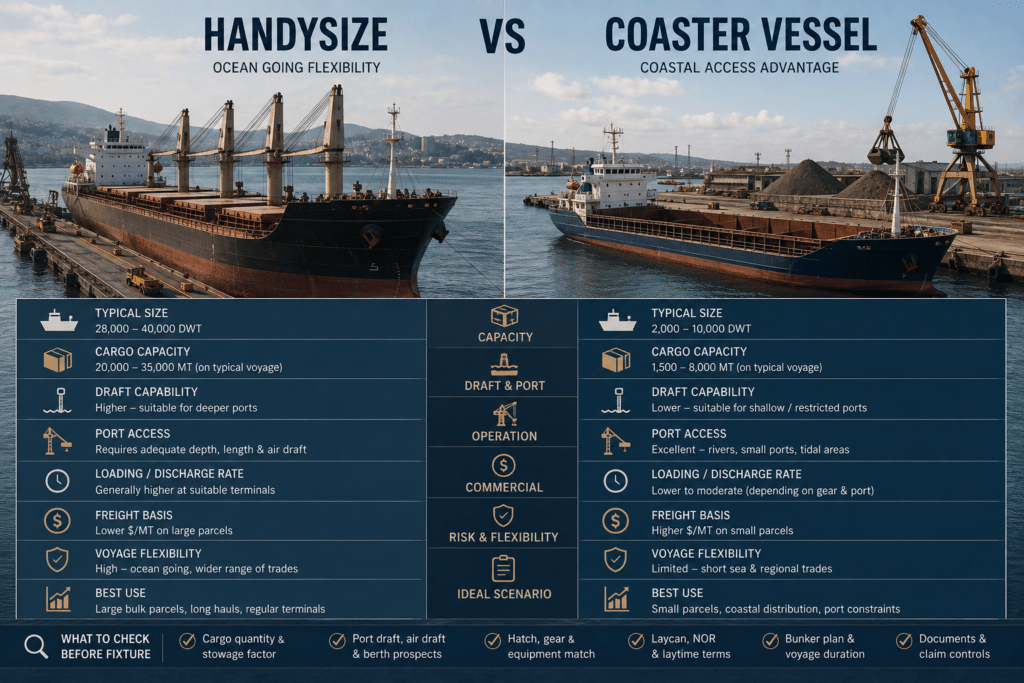
A cargo inquiry can look workable until the vessel reaches the loading port. A 7,000-ton parcel may fit a coaster’s nominal deadweight, yet fail on hatch access, stowage factor, berth draft, or discharge equipment. The handysize versus coaster vessel decision is therefore not a simple question of ship size. It is a voyage-feasibility decision made before a fixture creates cost and performance exposure.
For dry bulk and general cargo interests, the correct vessel is the one that can load, carry, and discharge the contracted parcel within the laycan and charter-party terms. Cargo owners, charterers, traders, and brokers should test that outcome against the actual ports, cargo characteristics, and operating sequence.
handysize versus coaster vessel: the working difference
A coaster is generally a smaller short-sea vessel designed for regional and coastal trades. The term does not define one fixed deadweight range, gear arrangement, or cargo capability. It can describe a small geared bulk carrier, a multipurpose vessel, or a vessel suited to restricted ports and rivers. Its practical value is access: smaller berths, shallow approaches, limited cargo parcels, and ports where a larger vessel cannot trade efficiently.
A handysize vessel is a dry bulk category, commonly used for vessels at the smaller end of the ocean-going bulk carrier market. The category also contains wide variation. A handysize may be geared or gearless, have different hatch configurations, and carry substantially different cargo quantities depending on its design and allowable draft.
The commercial distinction is usually clear. A coaster may serve a smaller parcel and a restricted port with less deadfreight risk. A handysize can spread voyage costs across more cargo and may offer stronger flexibility across several bulk and general cargo trades. But it requires sufficient water, berth length, air draft, cargo intake, and port productivity to justify its employment.
Neither label replaces a vessel questionnaire, class and statutory status review where required, or a detailed port check. The nominated vessel’s actual particulars control.
Start with the cargo, not the vessel label
Cargo quantity is the first filter, but not the last. A charterer fixing a coaster for a large parcel may accept deadfreight or need to split the shipment. A charterer fixing a handysize for a modest parcel may pay for unused carrying capacity and face a freight level that the cargo cannot support.
Stowage factor changes the answer. Dense cargoes such as minerals can reach draft limits before filling the holds. Light bulk cargoes can cube out before the vessel reaches its deadweight. Steel products require a separate assessment of hold dimensions, tank top strength, dunnage, lashing arrangements, segregation, and local loading practice. For bagged cargo or project-related general cargo, hatch dimensions and lifting capability may be decisive.
The cargo must also match the vessel’s certificates, hold condition, cargo-handling arrangements, and any charter-party requirements. A vessel that is physically large enough is not automatically suitable. If the cargo requires grabs, shore cranes, conveyor loading, trimming, or particular hold cleanliness, those points must be agreed before the fixture is treated as operationally sound.
Port restrictions decide feasibility
A coaster often has an advantage where tidal windows, channel depth, berth limits, or air-draft restrictions constrain a port. That advantage can disappear if the cargo quantity requires multiple liftings or if the port’s loading equipment is slow.
For a handysize, draft is normally the first operational test. The relevant figure is not only the published port depth. It is the permitted sailing draft at the expected time, after considering tide, under-keel clearance, freshwater allowance, trim, density, local restrictions, and any berth or channel limitation. The vessel’s tons per centimeter immersion also matters. It shows how much cargo must be reduced for each centimeter of lost draft.
Air draft deserves equal attention in ports with bridges, overhead loaders, or restricted river passages. A vessel may arrive safely but be unable to proceed with its intended ballast condition, mast configuration, or cargo profile. Confirm the applicable limit with the port authority or local agent for the intended call. Rules and working restrictions can change, so a prior port call is not sufficient evidence.
Berth prospects affect both cost and laytime exposure. A handysize may need a berth that can receive its length, beam, draft, and gang capacity. A coaster may obtain access more easily, but its smaller cargo intake can increase the number of calls needed for a larger program. The right choice depends on whether the savings from direct access exceed the cost of additional liftings, port calls, and documentation.
Gear, grabs, and productivity change the freight calculation
A geared vessel can be useful at ports without dependable shore cranes. However, crane outreach, safe working load, grab compatibility, cycle time, and local labor arrangements must be checked. Vessel gear does not guarantee that a cargo can be handled at the required rate.
For bulk cargoes, ask how loading and discharge will actually occur. Is the terminal using conveyor belts, hoppers, grabs, mobile cranes, or ship’s gear? Who supplies grabs? Is trimming included? Are night operations permitted? Is there a restriction on dust, rain, wind, or cargo spillage? These details influence the realistic loading and discharge rate, which then affects laytime and the risk of demurrage or despatch.
A smaller coaster may discharge efficiently at a compact berth with limited shore infrastructure. A handysize may perform better at a terminal built for larger parcel sizes and continuous cargo flow. Published productivity figures should not be treated as a promise. The charter party, terminal terms, and agent’s current operational advice require case-specific review.
Compare the voyage, not only the daily hire or freight
The lower freight indication is not necessarily the lower voyage cost. For a coaster, consider whether the parcel must be split, whether bunkers are available on the intended route, and whether weather or sea conditions may reduce schedule resilience. For a handysize, calculate the effect of ballast distance, port dues, canal or straits requirements where applicable, cargo intake limits, and waiting time at a larger berth.
Weather exposure should be considered early, especially for Black Sea and Mediterranean voyages where seasonal conditions can affect port access, anchorage operations, hatch work, and passage planning. For Turkish Straits transits, passage requirements, traffic conditions, pilotage arrangements, and local notices must be confirmed for the specific vessel and date. Do not build a fixture model on an assumed transit or port window.
Laycan must be realistic for the vessel’s prior employment, ballast voyage, bunkering plan, and readiness requirements. A tightly priced fixture can become expensive if the nominated vessel cannot meet the cancelling date or arrives without holds ready for inspection. The notice of readiness provisions should match the agreed port, berth, weather, and cargo-readiness conditions. Charter-party wording controls the result.
Post-fixture discipline protects the original decision
Once the vessel is fixed, the comparison between handysize and coaster becomes an execution plan. Voyage orders should state cargo, quantity tolerance, loading and discharge ports, laycan, charter-party references, freight terms, agency instructions, and documentary requirements without ambiguity. The operator must then test the order against the vessel’s current condition and the port’s confirmed restrictions.
Hold readiness comes before a rejected inspection delays the loading window. The stowage plan should reflect cargo distribution, stability, allowable drafts, stress limits, segregation, and discharge sequence. Draft surveys require coordinated timing and clear records. If a discrepancy arises, the facts should be documented through survey reports, statements of facts, and, where appropriate, letters of protest.
Document control is not an administrative afterthought. Mate’s receipts must match the cargo condition and quantity actually received. Draft bills of lading require careful review before signature authority is used. Freight invoices, SWIFT payment evidence, original bills of lading, and any letter of indemnity procedure must follow the agreed instructions and the applicable risk controls. P&I attendance, local law, and charter-party obligations may require separate advice in a specific case.
At discharge, the file should capture notices, port logs, statements of facts, time sheets, cargo records, and agency disbursement accounts. PDA estimates should be reviewed before the call where possible, then checked against the final D/A after completion. Laytime calculations need the correct notices, exceptions, interruptions, and agreed rate terms. A missed timestamp or an unsupported protest can alter a demurrage or despatch position.
emiroglu shipping approaches this work as an Istanbul-based, family-owned dry bulk and general cargo shipping business operating since 1998. Practical involvement in chartering and vessel operations means the commercial choice is tested against the cargo, port, and documents that will govern performance.
The useful question is not whether a handysize or coaster is generally better. Ask which vessel can carry this parcel, through these ports, under these terms, with a realistic margin for the events that occur after the fixture is signed.